


In this article we explore water usage, water saving measures, and why it matters with evaporative coolers. On an individual, community, national and international level, we must take a proactive approach to preserve water resources, mitigate the risk of water scarcity, maintain public health and support economic growth.

In this article we explore water usage, water saving measures, and why it matters with evaporative coolers, also known as adiabatic cooling.
Clean air, a stable electricity grid, and reduced greenhouse gas emissions are critically important to society – all features of sustainable evaporative cooling that leverages nature’s most powerful, renewable refrigerant to cool people with less than half the water of last century’s technology.
Despite its technology advancements, evaporative cooling is under increasing pressure, and in some cases outright prohibited, in arid regions where it is most effective, because of the misconception that it wastes a precious resource; water.
Firstly, let us explore water quality, before understanding how it affects evaporative coolers and the management of water in today’s technologies.
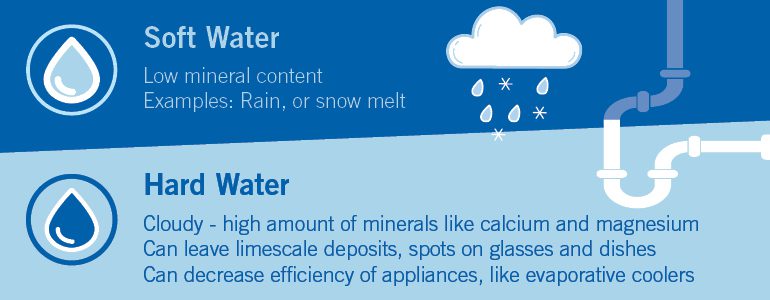
Not all water is created equal. Hard VS Soft water: What’s the difference?
Hard water is defined as having a higher mineral content of calcium and magnesium. Soft water, such as rain, has a much lower mineral content. Knowing where your water lands on the scale becomes especially important when analysing the impact it has on the lifespan of water-using appliances and their maintenance requirements.
Why does this matter for evaporative coolers?
Evaporating six litres of water generates over a ton (3.5kW) of cooling effect, but will leave behind any minerals that were present in the water. If those minerals are “hard”, like calcium and magnesium, they will bond to the evaporation surface, degrading cooling performance and eventually stopping the system from functioning at all. The “harder” the water, the quicker the buildup of minerals. Draining water before hard minerals fall out of solution therefore serves the engineering purpose of protecting the client’s investment in a high performing, long-serving HVAC system.